Table of Contents
This article was created with AI assistance and editorially reviewed by Filmovo.
A medium-sized enterprise has often gathered the best arguments long ago – just in the wrong format. A satisfied customer, a project that was finished on time despite supply bottlenecks, a system that has been running for three years without failure. All of that then ends up in a PDF reference list that is sent as an attachment with the proposal and that hardly anyone opens. Exactly at this point, the project portrait format comes in: a film that does not put the company itself at the centre, but rather a single, completed project – told by the customer who commissioned it.
One Project portrait is fundamentally a reference film with one clear rule: the company does not speak, its customer does. The end customer recounts on camera what the initial problem was, how the collaboration went, and whether they would work with the same partner again. Unscripted, without actors, without pre-written text blocks. This is what distinguishes the format from a classic customer testimonial on a website, which is usually only two sentences long and generally self-written or at least heavily edited.
By the way, the name Project Portrait® is a registered wordmark belonging to Filmovo, which developed this format as an independent service. Other providers usually offer similar formats as an additional option under „reference video“ or „case study film“. However, this makes no difference to the content or the impact on the viewer – what counts is the production style, not the name.
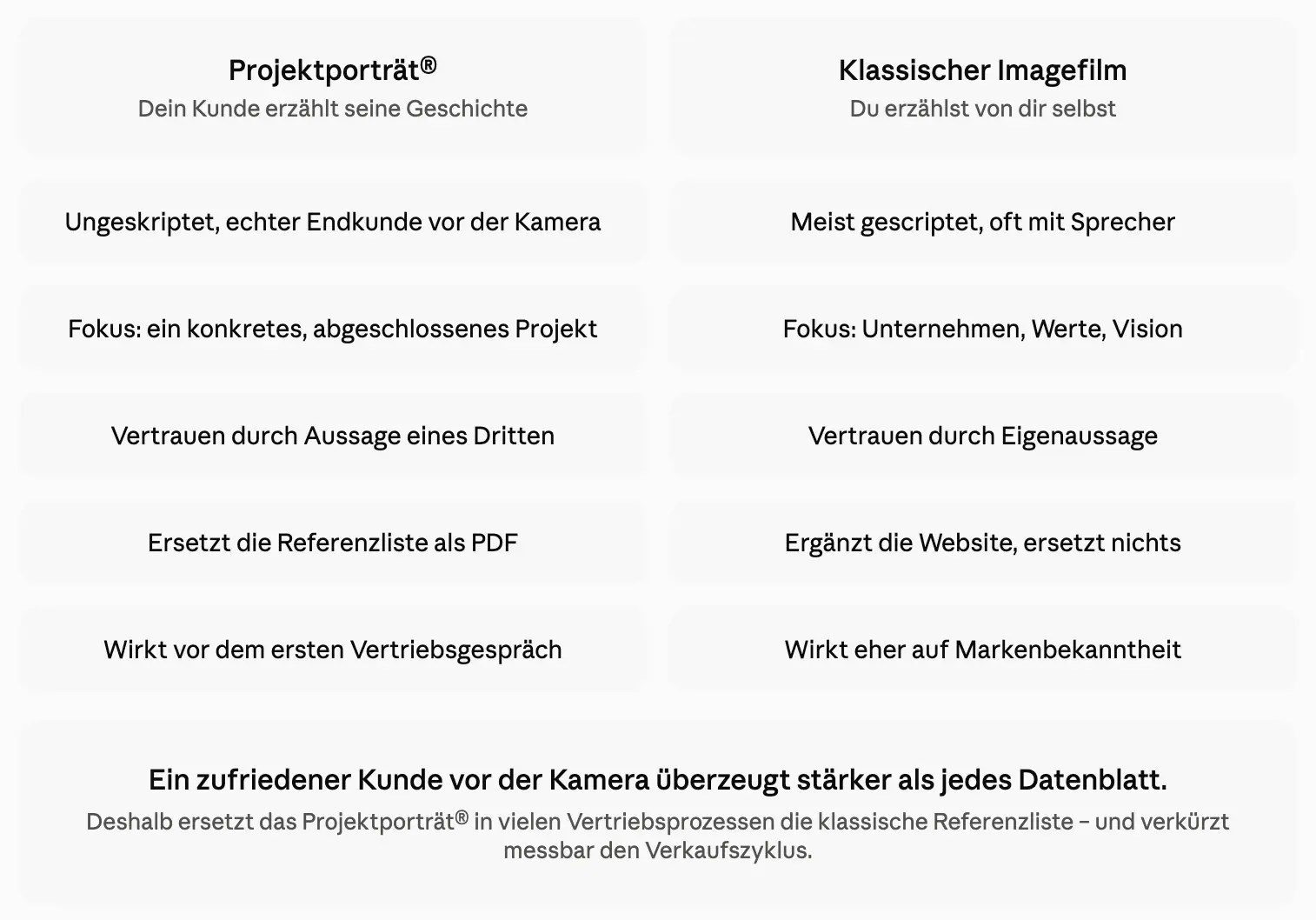
Psychologically, the reason is simple and well documented: people trust the assessment of other customers significantly more than a company's own claims. A salesperson who says „we deliver reliably“ is doing exactly what every salesperson says. A customer who says „they delivered by the originally planned deadline despite a two-week delay in dispatch“ tells a verifiable story with a concrete detail. It is this detail that sticks in the mind.
The difference compared to the classic corporate film therefore lies not in the visual language, but in the narrative perspective. A corporate film shows who a company is – values, team, machinery. A project portrait shows what was done for someone else, and lets precisely that someone judge. For a prospective customer who currently has a similar challenge, the latter is often the more relevant information: they want to know whether the problem they themselves have has been solved before – and how satisfied the previous client was with it.
A project portrait only works if it remains concrete. General statements like „the collaboration was good“ are of little use. It becomes interesting when details are mentioned: which technical problem was solved, what alternative there would have been, why the client chose this partner, what went wrong during the project and how it was handled.
A few Real-world examples show how different that can look:
What these examples have in common is that it is never about the supplying company as such, but always about a specific problem and its solution.
Unlike a spontaneous interview, a project profile needs preparation, otherwise the desired „authentic and unscripted“ quickly turns into an unstructured conversation without a common thread. In practice, such a shoot usually takes place in several stages:
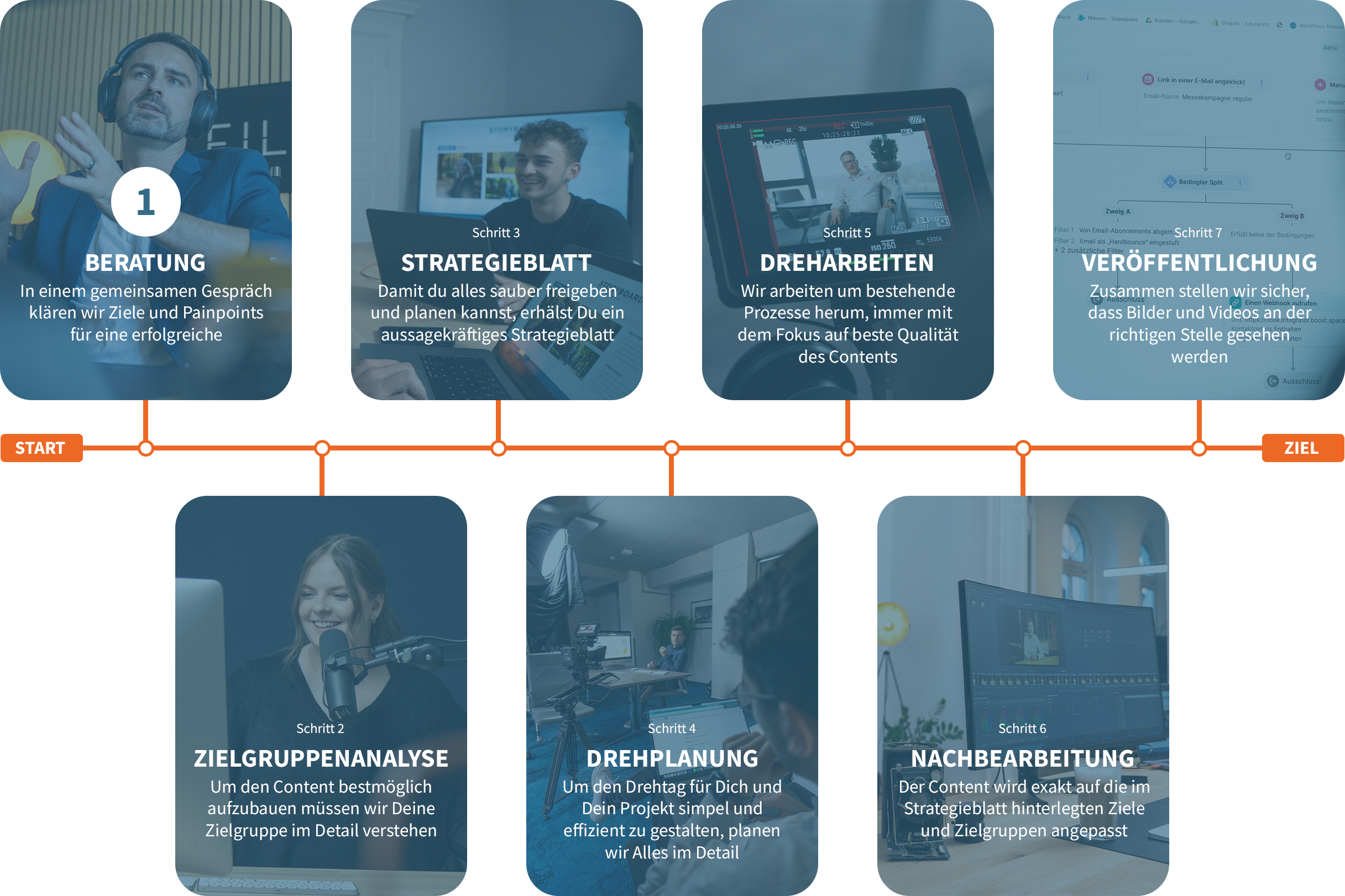
So the effort lies less in the filming itself than in the editing. Two to three hours of raw footage has to be turned into a film that tells a coherent story in three to five minutes – plus shorter clips for social media that are often only 30 to 60 seconds long.
Basically, the format works wherever there are completed projects and satisfied customers – which practically applies to every mid-sized B2B business. However, it is particularly well-suited for industries with services that require explanation: plant engineering, mechanical engineering, construction, plastics technology, the energy sector, and hydrogen technology. In these areas, a text or a photo is often not enough to convey what was actually achieved.
A construction company that has laid a floor with a special needlefelt covering can describe this in a single sentence – or show it in a film in which the school management, sales partners and even a head boy or girl have their say and explain from different perspectives why the decision was worth it. The second approach stays in your head for longer.
Publishing a project portrait on social media alone is the most common mistake made with this format. Views are a start, but without a clear next step for the viewer, they remain just that: views, with no measurable impact on the number of enquiries. A software provider for digital tool logistics therefore combined its project portrait with a dedicated landing page where interested parties can get in touch directly, rather than having to search via the general corporate website first.
The format is used correspondingly broadly: for acquiring new customers, in classic reference marketing, for brand positioning – on LinkedIn, the company website, in proposal presentations or at trade fairs, where a well-told project often goes down better than a static image at a trade fair stand.
If you are wondering whether such a format would also be useful for your own company, you will regularly find further examples and insights in our newsletter on how other small and medium-sized enterprises practically implement reference customer marketing.
A project portrait doesn't replace a website or sales, but it solves a very specific problem: that a business's best reference is usually in a form that nobody reads voluntarily. Instead of hiding a completed collaboration in a PDF list, it gets a face, a voice and a traceable process – told by the person who can ultimately judge whether the collaboration was worth it. What matters less is the technology behind the filming than the attitude behind it: staying concrete, giving the stage to the client and actually using the film afterwards where prospective customers can see it and react to it.
Together with our strategy consultant Christian, you can discuss your open questions, ideas or challenges. Christian himself has worked in construction and industrial companies and is therefore familiar with the topics you are dealing with. Book a no-obligation appointment now and benefit from our experience from over 100 marketing projects with companies like yours.
