Table of Contents
Your advert is running, the click numbers are good, but the phone is still not ringing. The potential customer asks twice if you've really done the project before. That's precisely where it's decided whether a click turns into a customer – and this decision is rarely made because of a clever animation, but because of a face that the potential customer knows or at least believes to be real.
Animation and live-action film are often presented side by side in proposals as equally valid options, as if the choice were purely a matter of taste. It isn’t. Both have their place, but only one of them actually builds trust in B2B sales. And trust is the factor that determines whether you get genuine enquiries rather than just reach – especially now, when AI-generated adverts and stock footage video builders are flooding every feed.
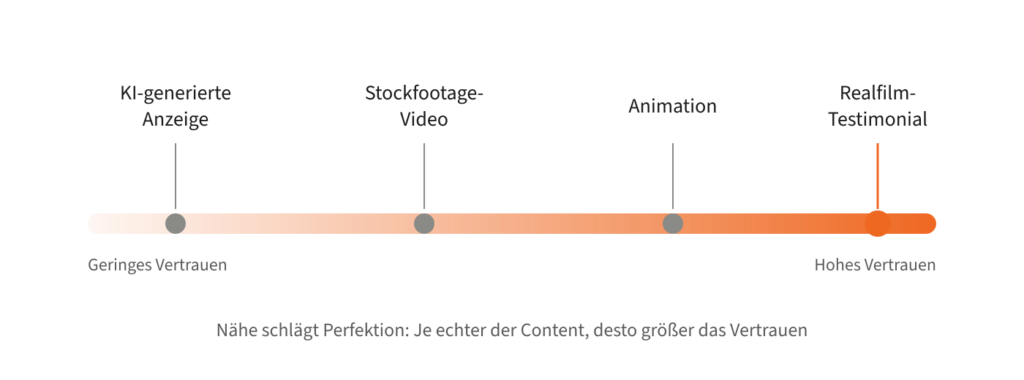
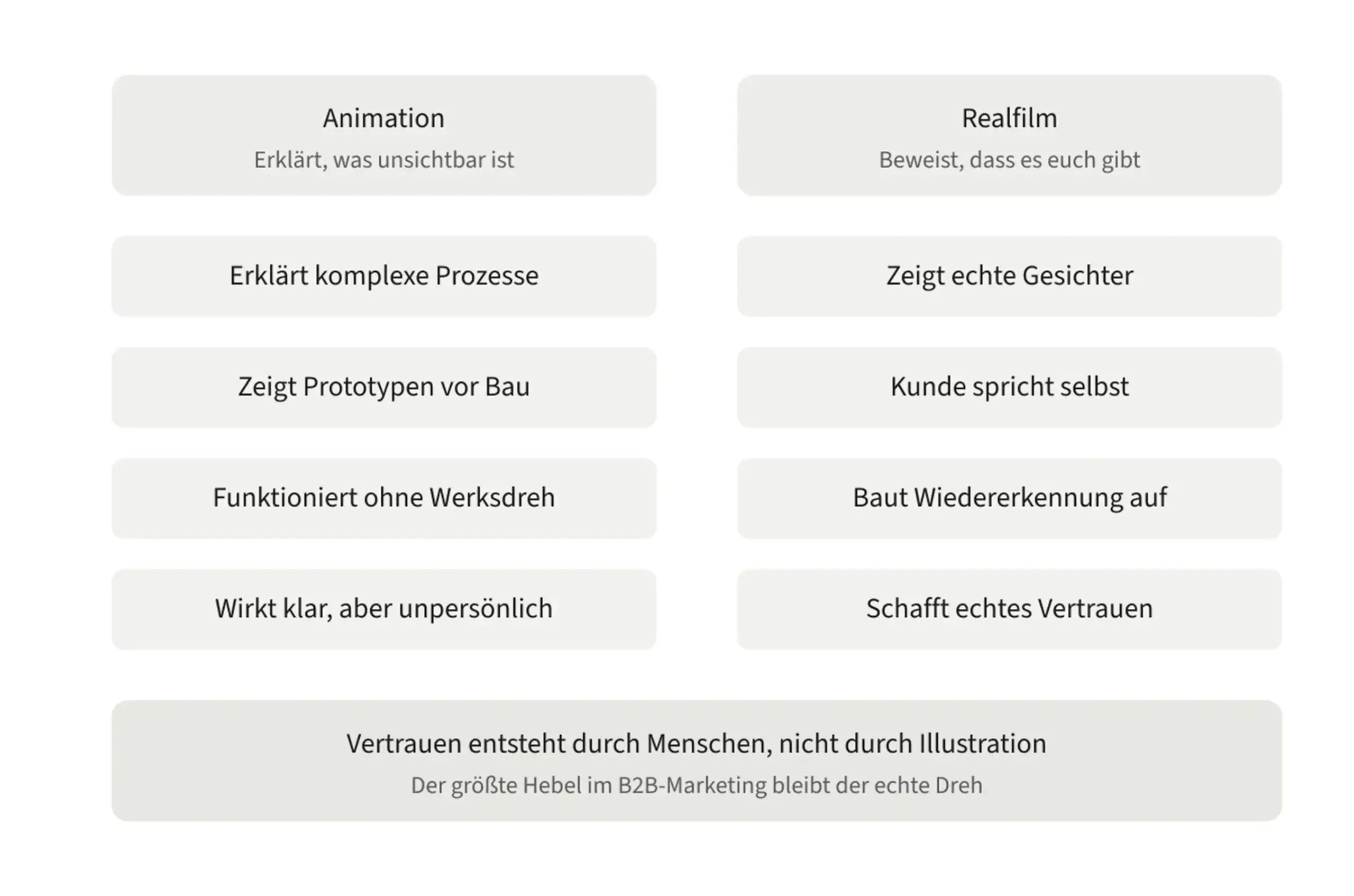
Animation explains. Live-action proves. That is the crux of the difference, and everything else is just embellishment.
An animation can make a manufacturing process understandable in 45 seconds that would otherwise take a two-hour factory tour to grasp. It reduces complexity to the essentials, excludes disruptive factors and works regardless of whether your factory floor is tidy or not. That is its strength – and its limitation at the same time: an animation never shows that you, your customers and your team really exist.
Real films, on the other hand, show precisely that. Real factories, real construction sites, real faces. And in B2B marketing, where purchasing decisions involve sums in the five- to seven-figure range and are rarely made by a single person, this very demonstrability is the crucial lever.
We do not advise against animation across the board – that would be dishonest and would not do justice to the reality in industry and plant construction.
Animation is the right choice when:
A real-life example: A plant manufacturer wants to sell a new filtration system that currently exists only as a CAD prototype. In this case, animation is not only a sensible option, but the only viable solution. Filming live-action footage is simply not an option, as there is nothing to film yet.
But this is precisely the trap that many small and medium-sized businesses fall into: they use animation even in situations where they really ought to be showing something – out of convenience, for cost reasons, or because an agency has sold them a ready-made animation package that looks the same for every industry.
This brings us to the crux of the matter, and we make no secret of our opinion on this: when it comes to building trust, live-action films featuring real people are miles ahead of any animation. Not just by a narrow margin. By a wide margin.
The reason is psychologically simple. People trust people, not illustrations. When a construction manager talks on camera about why the collaboration with your company went smoothly even with a delayed schedule, something happens that no motion design team can replicate: the viewer projects themselves into this situation. They don't think „nice animation“, they think „that could be my project too“.
Exactly that is the principle behind our Project portrait-Format. We don’t simply produce a promotional film about your company; instead, we let your customers talk about their experience of working with you – including the challenges they faced and how you resolved them. One main film, three shorts for social media, plus stills. The result: a prospective client not only sees that you can deliver, but hears it from someone who is in exactly the same situation.
Here’s an example we often come across: a medium-sized electrical engineering firm had been posting nothing but photos of installations and product shots for years. Click-through rates were mediocre, and enquiries were few and far between. It was only when the project manager himself appeared on camera and spoke about a tricky refurbishment project that enquiries started to pick up – because prospective clients could suddenly see who they were dealing with before the first phone call had even taken place
The same mechanism works in recruitment, only the other way round. Instead of customers, employees explain why they’ve stayed rather than moved on. For job seekers choosing between three similar construction firms in the region, a 30-second short film featuring a real foreman on a building site is more credible than any careers page featuring stock photos of smiling models in suits who’ve never even seen an excavator.
This is precisely why social recruiting is not an afterthought for us when it comes to film production, but is considered from the outset: funnel building, Meta ads, creatives – and always with the genuine faces of the company at the centre.
The best solution is rarely „either/or,“ but rather a clear division of tasks. Use animation where processes need to be explained that the eye cannot otherwise grasp. Use live-action film where it concerns people, trust, and purchasing decisions.
A typical setup that works for our medium-sized business clients:
This way, the viewer gets both understanding and credibility. The only important thing is that animation remains the exception and doesn't become a substitute for actual filming, because it is supposedly easier to plan.
This is where it gets down to the nitty-gritty for the budget. AI-generated adverts are now recognisable to everyone – smooth voices, perfect faces, interchangeable stock footage. That is precisely why the value of genuine, distinctive content is rising rapidly right now. Any small or medium-sized business that shows there are real people with genuine experience behind its offering will automatically stand out from the sea of AI-generated content currently flooding every feed.
This means that trust is no longer just a soft marketing factor, but a hard sales metric. A prospective customer who has already been convinced by a customer testimonial before they even ring up will negotiate differently from someone who still needs to be persuaded from scratch. This saves sales time, shortens the sales cycle and increases the conversion rate – without you having to change the price at all.
This is exactly where our VIP Partnership We don’t view content, lead generation and recruitment as separate entities, but rather as an external marketing department that understands that a plant engineering firm needs to address different trust-related issues than a software start-up. All this for a monthly fee that’s lower than the cost of a full-time marketing employee.
Use animation when you need to explain. Use live-action when you need to persuade. In B2B sales for small and medium-sized enterprises, the latter is almost always the bigger lever – because purchasing decisions are made by people who want to trust other people, not illustrations.
If you’d like to find out what a project profile for your business might look like and which format suits your sales situation, let’s have a quick chat. In a no-obligation initial consultation, we’ll work together to identify where trust is currently lacking in your business – and how we can change that with authentic content.
Together with our strategy consultant Christian, you can discuss your open questions, ideas or challenges. Christian himself has worked in construction and industrial companies and is therefore familiar with the topics you are dealing with. Book a no-obligation appointment now and benefit from our experience from over 100 marketing projects with companies like yours.
